The Lesson That Wasn’t in the Lesson Plan: A Sprout, Acid Rain, and the Resilience of Life
Aina ei mennä käsikirjoituksen mukaan. Näin tapahtui, kun argentiinalainen opettaja Sebastian Chiapella teki happosateen vaikutusta kasveihin tutkivan laboratoriokokeen yhdessä oppilaidensa kanssa. Hypoteesi oli, että kaikki kasvit kuolevat lopulta, mutta luonnon uusiutuminen ja sopeutuminen yllätti kaikki. Englanninkielinen artikkeli kertoo laboratoriokokeesta ja suuresta yllätyksestä sen lopussa.
Many of the most meaningful lessons in the classroom don’t come from what was planned, but from what wasn’t. This article describes a Natural Sciences laboratory experience carried out with students aged 13 and 14, in which two small ecosystems built inside a fish tank were exposed to controlled concentrations of sulfuric acid and nitric acid in order to observe the effects of acid rain on ecological balance. Although the initial goal, understanding how acid pollution affects living organisms, was fully met, the spontaneous appearance of a green sprout in one of the ecosystems believed to be beyond recovery opened up a reflection that had not been part of the original plan. Starting from that discovery, the class turned into a conversation about people’s capacity to recover from adversity, enriched by one student’s account of a family member’s recovery after a serious accident. The article proposes that scientific observation, when paired with attentive listening to the unexpected, can become a gateway to learning that reaches beyond the original curricular content.
An Ecosystem Designed to Collapse
When I saw that small green sprout growing in the middle of an ecosystem we all believed to be completely destroyed, I understood the experiment wasn’t over yet. In fact, the most important lesson of the whole project was only just beginning.
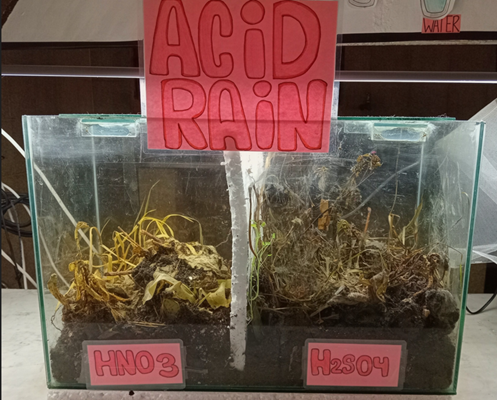
That morning I walked into the lab as I do every day, to check on the various trials we run with my students. One of them had already met its objective. For weeks we had watched a small ecosystem deteriorate slowly, until it was reduced to dry branches, wilted leaves, and a landscape where it seemed impossible for life to return; and yet, there it was: a small plant had managed to push its way through everything that had seemed lost for good.
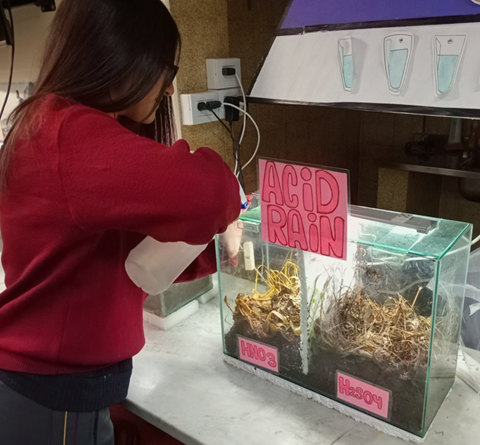
The project had begun several months earlier with students aged 13 and 14. Our purpose was to understand the effects acid rain can have on ecosystems. To do that, we built two small experimental environments inside a fish tank, using soil, plants, and small organisms the students themselves brought from home. We were trying to represent, in the simplest way possible, the balance that exists in any natural ecosystem. To speed up a process that can take years in nature, we used sulfuric acid and nitric acid at concentrations far higher than those found in real acid rain. We weren’t trying to reproduce the natural phenomenon exactly, but to create an extreme situation that would let us observe its consequences within the timeframe of a school project.
As the weeks went by, the changes began to appear: the leaves lost their color, the stems dried out, and the ecosystem slowly turned into a completely degraded environment. The students could clearly see how a severe environmental disturbance alters an ecosystem. The content we had set out to teach had been covered. But something happened that, at the time, didn’t seem to carry much weight. I kept watering the ecosystem; I wasn’t doing it because I expected an extraordinary result, I was doing it because after many years of studying biology, I had learned that life has an extraordinary capacity to persist. The great extinctions our planet has gone through showed that, even after the most devastating events, there were always organisms capable of surviving and starting over. I thought that, as long as even the smallest possibility remained, it was worth continuing to care for it, and I never imagined that decision would end up completely changing the meaning of the project.
From Acid Rain to Resilience
When I discovered the small green sprout, I knew I had to show it to my students. In the next class, we gathered in front of the tank again; at first everyone fell silent, and then the questions began. How could it have survived when the tank was full of sulfuric acid? Everything was dead… but it managed to survive.
Those questions marked the beginning of a conversation none of us had planned. We were no longer talking only about acid rain; we were talking about life’s enormous capacity to find its way back when everything seems lost.
I then suggested they think of that small plant as also representing people; I told them that all of us, at some point, go through difficult situations. Sometimes we feel we have no strength left to go on, and yet, quite often, there’s a small seed that stays alive and that, given time, help, and support, grows again.
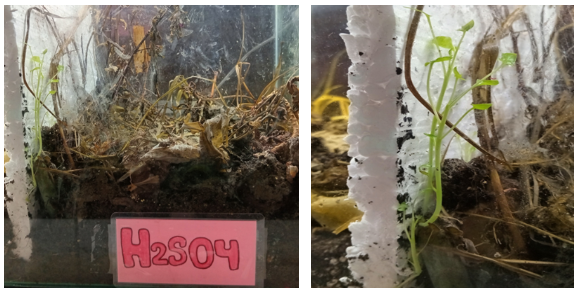
That was when one of the students asked to speak; visibly moved, he told us that a close family member had suffered a serious accident. For a long time, the family thought he would never recover, yet the support of his loved ones and the work of healthcare professionals made it possible for him to rebuild his life, return to work, and reunite with his family. As we all listened, I understood that the small plant had stopped being just a biological result and had become a concrete image of resilience.
When we began this project, we wanted to teach how pollution can alter an ecosystem. That goal was met. The students understood what acid rain is, how it forms, and what its consequences can be for living things. But a lesson emerged that wasn’t in any lesson plan: we came to understand that nature has an enormous capacity to recover when it finds the conditions it needs, and we also understood that people often need exactly the same thing. We need time; we need someone to believe in us; we need someone to keep ”watering” us, even when everything seems lost.
What the Experiment Kept Teaching
As a teacher, one of the things I love most about science is precisely its capacity to surprise us. We often think an experiment ends once we get the results we expected. And yet some experiences keep teaching us long after they’ve met their objectives. That small plant appeared when the experiment seemed to be over, and perhaps that’s exactly why it left us with the deepest lesson of the whole project.
Acid rain was the topic on the lesson plan; resilience was the lesson that showed up afterward.
Bibliografy
Likens, G. E., & Bormann, F. H. (1974). Acid rain: A serious regional environmental problem. Science, 184(4142), 1176–1179. https://doi.org/10.1126/science.184.4142.1176
Holling, C. S. (1973). Resilience and stability of ecological systems. Annual Review of Ecology and Systematics, 4, 1–23. https://doi.org/10.1146/annurev.es.04.110173.000245
Masten, A. S. (2001). Ordinary magic: Resilience processes in development. American Psychologist, 56(3), 227–238. https://doi.org/10.1037/0003-066X.56.3.227
Minner, D. D., Levy, A. J., & Century, J. (2010). Inquiry-based science instruction—What is it and does it matter? Results from a research synthesis years 1984 to 2002. Journal of Research in Science Teaching, 47(4), 474–496. https://doi.org/10.1002/tea.20347
Southwick, S. M., & Charney, D. S. (2012). Resilience: The science of mastering life’s greatest challenges. Cambridge University Press. https://www.cambridge.org/core/books/resilience/5EFAE0C9F315B0BA2FD90D9129AD217A
Chawla, L. (2020). Childhood nature connection and constructive hope: A review of research on connecting with nature and coping with environmental loss. People and Nature, 2(3), 619–642. https://doi.org/10.1002/pan3.10128
Kirjoittajasta:
Sebastian Alberto Chiapella on argentiinalainen biologian, fysiikan ja kemian opettaja sekä Instituto Superior del Profesorado Joaquín V. González -laitoksen (Buenos Aires, Argentiina) alumni. Hän on työskennellyt 27 vuoden ajan kaiken ikäisten kanssa nuorista aikuisiin. Hän on erikoistunut laboratoriotyöhön: hän suunnittelee kokeita opiskelijoidensa kanssa tieteellisten hypoteesien testaamiseksi, etsien aina yhteyttä todellisen maailman kysymyksiin, jotka perustuvat luonnon ja yksilön kunnioitukseen. Tällä hetkellä hän opettaa Schönthalin koulussa, La Candelaria -koulussa ja Cárdenas Schoolissa sekä on toiminut opiskelijaohjaajana ja biologian osaston johtajana.